How to Water Your Lowcountry Lawn Properly: The Complete Guide to a Greener, Healthier Yard
Knowing how to water your lawn properly is one of the most impactful things you can do for your yard’s long-term health. Too little water stresses the grass. Too much invites disease, fungus, and wasted money.
At T&T Lawn and Landscape, we work with Charleston homeowners and commercial property owners every season, and improper watering is one of the most common issues we see. The Lowcountry’s sandy soil and subtropical climate make getting this right even more important. This guide gives you a clear, practical framework for watering your lawn the right way.
When and How Often to Water Your Lawn
Water your lawn early in the morning, before 10 a.m. Cooler temperatures and calmer winds during those hours reduce evaporation significantly, meaning more water actually reaches the root zone. Watering at night is not ideal, as prolonged moisture on grass blades increases the risk of fungal disease, which is a real concern in Charleston’s humid climate.
Most established lawns do not need daily watering. Deep, infrequent watering, roughly one to three times per week, produces stronger turf than daily shallow applications. The goal is to encourage roots to grow downward in search of moisture, not stay shallow where they’re vulnerable to heat and drought stress.
Adjusting Your Watering Schedule by Season and Grass Type
Your watering schedule should shift with the seasons and match your grass type. During hotter months, turf may need watering two to three times per week. In cooler periods, once per week or less is often enough.
Newly seeded or sodded areas are the exception. Keep the top inch of soil consistently moist until germination or root establishment, then transition to a standard deep-watering schedule.
How Much Water Your Lawn Actually Needs
A healthy established lawn needs about one to one-and-a-half inches of water per week, including any rainfall. That total should penetrate six to eight inches into the soil to reach the root zone where it matters most. Anything less than that and the grass stays stressed: anything more and you risk waterlogging and runoff.
A simple way to measure your output is to place several flat-bottomed cups or a rain gauge across your lawn while your sprinklers run. Time how long it takes to collect one inch of water. That run time becomes your baseline. Subtract any rainfall from the weekly total, so you’re not overwatering during wetter weeks.
Sprinklers, Irrigation System Installation, and Watering Tools in Charleston
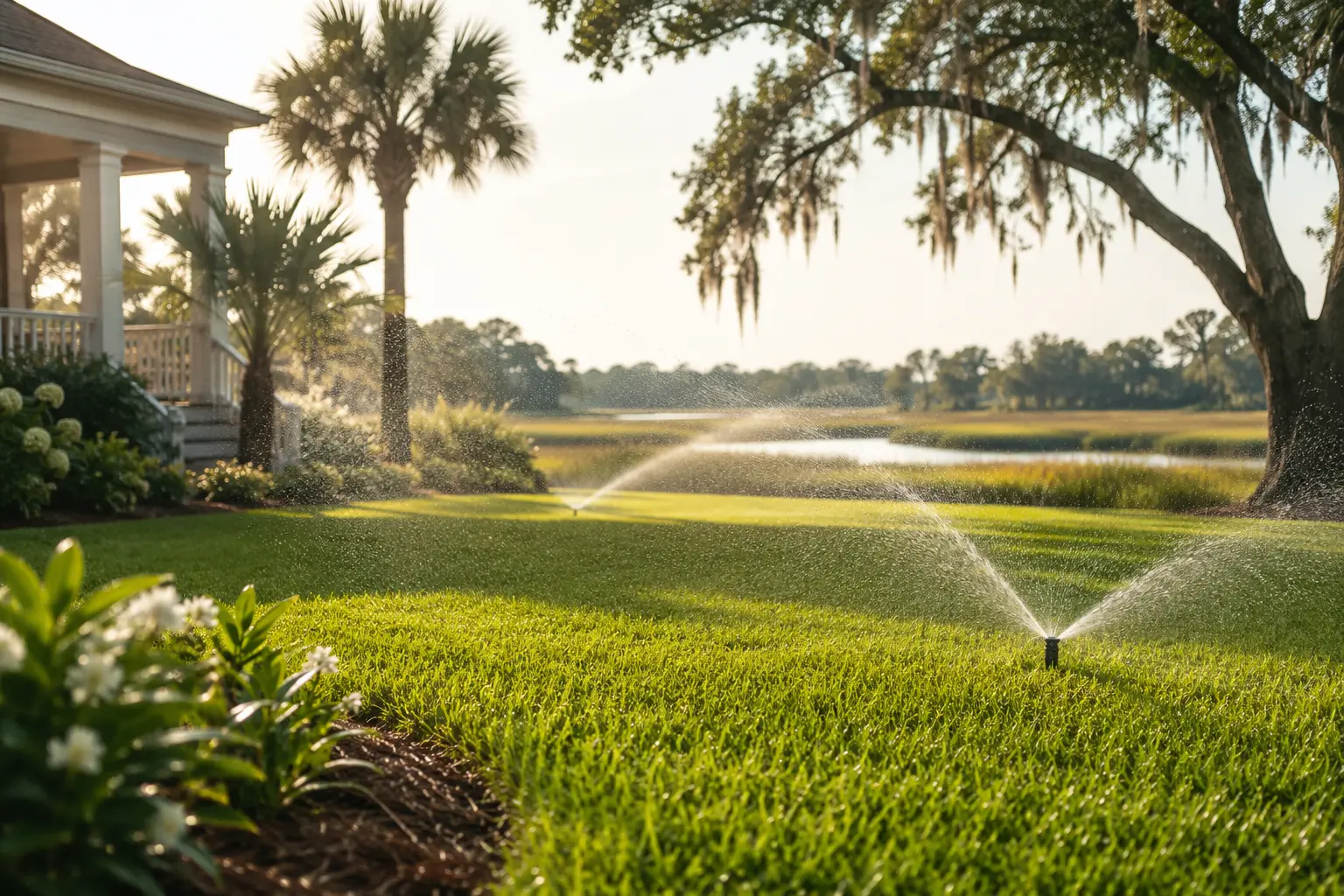
The right tools make consistent, effective watering far easier to manage. A basic oscillating or rotary sprinkler works for smaller residential lawns, but for larger properties or commercial grounds, a professionally installed irrigation system delivers far better coverage and control. At T&T Lawn and Landscape, we handle full irrigation installation and repair across Charleston. We install systems designed to apply the right amount of water to each zone without waste.
Rain sensors and soil moisture sensors are worth the investment. These devices automatically pause your system when rainfall is sufficient or soil moisture is already adequate, preventing overwatering on days when nature handles the job. Without them, automated timers run regardless of conditions.
For homeowners who want a low-tech check, a simple screwdriver works well. Push it six inches into the soil, if it goes in easily, the ground has enough moisture. If it meets resistance, your lawn likely needs water.
Signs You’re Overwatering or Underwatering
Your lawn will tell you when something is off. The key is knowing which signals point to underwatering and which point to overwatering, because both can make grass look stressed.
Signs of underwatering:
- Grass blades fold or curl inward
- Lawn takes on a dull, grayish-green color instead of a healthy green
- Footprints remain visible for more than a few seconds after walking across the lawn
- Soil feels dry and hard when you press a screwdriver into it
Signs of overwatering:
- Soil feels soggy or squishy underfoot
- Puddles form during or after watering
- Fungal patches, mushrooms, or excessive thatch appear
- Weeds and moss increase, particularly in low spots
In Charleston, overwatering is often the more common mistake, especially in neighborhoods with automated irrigation systems set on fixed schedules.
Water Smarter and Your Lawn Will Show It
Proper lawn watering comes down to a few consistent habits: water early in the morning, water deeply rather than frequently, measure your output, and adjust for seasons and rainfall. For Charleston properties dealing with sandy soil, salt exposure, and a long growing season, getting your watering schedule right is the foundation of a healthy lawn.
If you’d like help with irrigation installation, a recurring lawn care plan, or a full property assessment, T&T Lawn and Landscape is here. Reach us at 843-305-7025 or tandtlawnandlandscape.com to get started with a free estimate.